
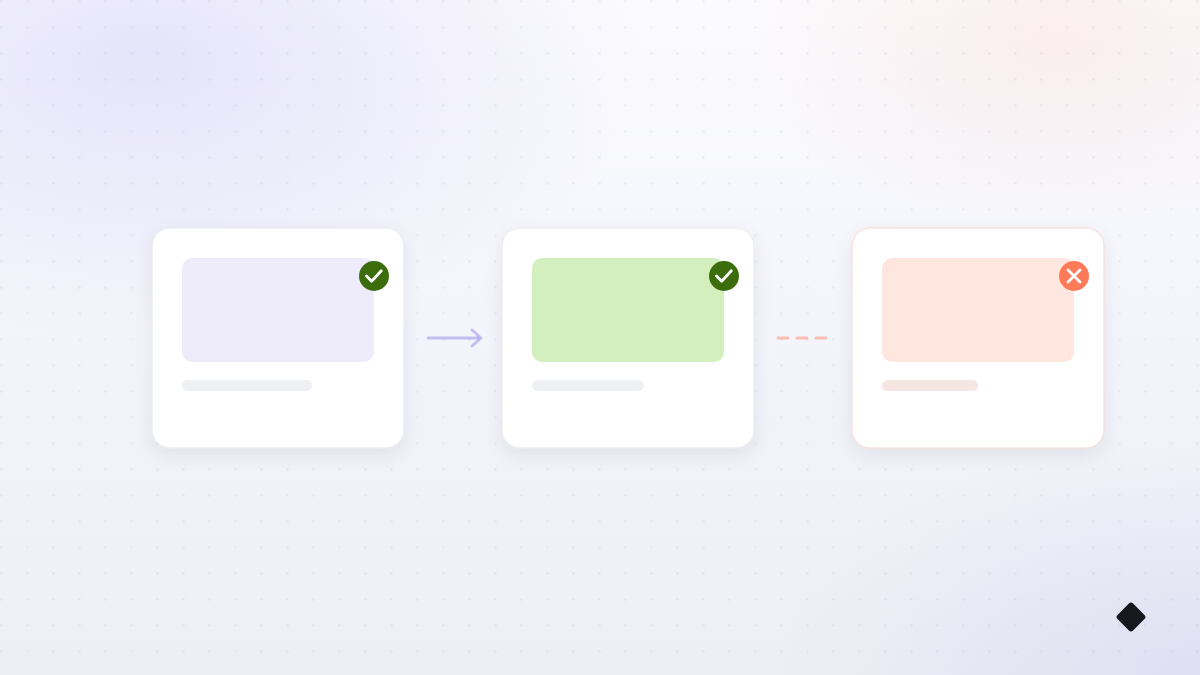
Three places a post can fail
A post that did nothing failed at one of exactly three points. Nobody saw it. People saw it and scrolled past. People read it and did nothing next.
These need opposite fixes, and the instinctive move is to rewrite the caption. That treats the second failure, which is the middle one, and roughly two thirds of the time the problem is somewhere else entirely.
Working out which of the three you have takes about ten minutes and turns a vague sense of failure into one thing to change.
Diagnose in order, never by instinct
The order matters because the gates are sequential. A post nobody saw cannot tell you anything about whether the writing works, so judging your captions on it is reading tea leaves.
Start at reach. Only once reach looks normal for you does the engagement number mean anything. Only once people are genuinely stopping does the absence of enquiries point at your call to action.
Skipping a step is the single most common way owners end up rewriting perfectly good posts for months.
Worked through: a florist decides her captions have gone stale and rewrites a month of them with no improvement. Checking reach first would have shown it down by half after a three-week gap over the holidays. The captions were never the problem, and the fix was posting again rather than writing differently.
First: is anyone seeing it
Compare this post's reach against your own recent average rather than against anyone else. Your average is the only fair benchmark, and three months of your own figures are what make the comparison meaningful, as a steady posting rhythm is what produces them.
If reach is well down, the causes are usually mechanical. Posting has become irregular, so the account looks dormant. The format is one the platform is currently showing less of. Everything goes out at the same hour to the same people. A link in the first line pulls distribution down on some platforms.
Second: does anyone stop
With reach normal, look at interactions divided by reach. A low rate means the post arrived and lost people in the first line or the first image.
Usually the subject was the problem rather than the wording. Posts about your business stopping fewer people than posts about your customer's problem is the most reliable pattern in small business social media, and no amount of rewriting fixes a subject nobody wanted.
One cheap check separates the two. Read only your first line and ask whether it would stop you. If it would, the subject is fine and the post lost people at the image. If it would not, no rewrite below it was ever going to be read.
Third: does anyone act
Good reach and a healthy stop rate with no enquiries is the most fixable case of the three, and the cause is almost always the same. The post never suggested a next step.
A next step has to be small and specific. Reply with a photo of your room. Message the word June for the two remaining slots. Ask a question you will genuinely answer. Vague invitations to get in touch read as decoration and get treated that way.
How long before you judge
A single post tells you nothing. Platform distribution varies enough week to week that one result is noise, and acting on noise is how accounts end up changing direction monthly.
Judge on a month, or on a group of eight to ten similar posts. Below that you are reading randomness. Above three months you have waited too long to learn anything useful.
The four usual causes
- Irregular posting. The most common and the least interesting answer. Gaps cost reach, and reach is the first gate.
- Always the same shape. Same opening, same photo composition, same length. Regular readers stop registering it.
- Talking about yourself. Announcements and milestones interest you more than they interest a stranger.
- Wrong platform entirely. Sometimes the account is healthy and the audience is elsewhere, which is a choosing problem rather than a posting one.
When none of it moves
If three months of consistent, varied posting on the right platform still produces nothing, the honest conclusion is that social is not where your customers decide. That is a real finding rather than a failure.
For some businesses the money belongs in search, referrals, or local partnerships instead. Knowing that after three months of a fair trial is worth more than another year of posting into a room nobody is in.
How Postd helps you tell
Diagnosis needs two things most owners lack: consistency, so the numbers mean something, and variety, so a weak week is not the whole account.
Postd supplies both. It prepares a week across your content pillars, so posts vary by design rather than by memory, and it keeps the cadence steady while you review.
You approve every post, and nothing publishes without your approval. The How it works page covers the loop. What it cannot do is decide that social is the wrong channel for your business, which stays the reading of the numbers described above.
Your next step: take your last ten posts, find which of the three gates they fail at, and change only that.